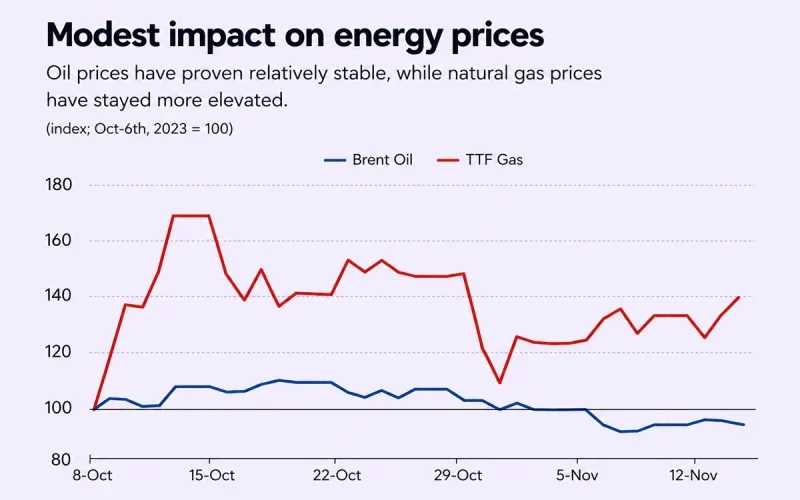
The prognosis for energy companies has improved recently as the industry has outperformed other sectors due to increased oil prices. Geopolitical pressures and supply issues related to the Iran conflict have fueled gains.
Now, traders are keeping an eye on whether the recent uptick can continue or if uncertainties related to costs, hedging, and worldwide demand will impede the sector’s growth.
Let’s explore the energy stocks rise due to oil prices in depth!
Oil Prices Rise Despite New Restrictions
2026 has seen a significant increase in oil prices, with Brent crude rising beyond $100 per barrel and reaching a top of about $118 in late March. Prices stay high in the mid-$90 range even after a decline.
Geopolitical threats, particularly those related to the Strait of Hormuz, have been a major factor in this increase. Global energy markets are under pressure to rise due to supply interruptions and uncertainties.
The current dynamics of oil prices are influencing attitude in the following ways:
- After rising beyond $100, Brent crude retreated to the $85–$100 region.
- West Texas Intermediate is still close to $93 per barrel.
- Supply forecasts are still impacted by the Iranian crisis.
- Because of geopolitical risk, market volatility is still high.
Analysts point out that oil may have already reached its short-term top despite robust pricing. For traders hoping for further gains, this creates uncertainty.
Note: Once tensions subside, oil price surges caused by geopolitical events can swiftly revert.
The Energy Sector Performs Better Than Wider Markets
This year, the energy sector has outperformed all other sectors in the S&P 500, gaining by almost 26%. Traders following the future of energy trading are closely watching how oil, gas, and renewable energy markets continue to reshape global commodity flows and investor sentiment.
The performance of the energy sector is broken down as follows:
| Metric | Current Level | Trend Direction | Impact On Earnings | Trader Focus | Risk Level |
| Brent Crude Price | ~$100 | Elevated | Higher revenue potential | Price sustainability | Medium |
| WTI Crude Price | ~$93 | Stable High | Strong pricing support | Demand outlook | Medium |
| Energy Sector Return | +26% YTD | Strong Uptrend | Earnings growth boost | Continuation trend | Medium |
| Oil Company Margins | Mixed | Under Pressure | Cost impact rising | Margin expansion | High |
| Hedging Exposure | Elevated | Limiting Upside | Locked lower prices | Contract roll-off | High |
| Geopolitical Risk | High | Uncertain | Cost volatility | Risk premium | High |
Although the industry has produced high profits, the underlying principles are more complex. Some of the advantages of rising oil prices are starting to be outweighed by growing expenses and operating hazards.
Alert: Consistent profit growth is not usually a result of strong industry success.
Why Profits Are Not Always Increased by Higher Oil Prices
The idea that rising oil prices inevitably translate into better profitability is a major fallacy in the forecast for energy stocks. In actuality, this association may be limited by a number of reasons.
Businesses frequently use futures contracts to hedge production, locking in prices well below current market levels. This implies that they are unable to completely profit from abrupt price hikes.
The primary issues preventing profit growth are as follows:
- Early in the year, hedging arrangements locked prices close to $60 per barrel.
- Growing insurance and security expenses in areas of conflict
- Disruptions in the supply chain raise operating costs
- Extension into safer areas necessitates more funding
Even when petroleum prices are rising, these pressures have the potential to lower profitability. Earnings growth may therefore fall short of projections based on headline oil prices. Be aware that hedging techniques can considerably lessen the effect that rising commodity prices have on profits.
Market Volatility and Geopolitical Risks
The volatility of the energy market is still mostly caused by geopolitical conflicts. Similar patterns are also visible in financial stocks volatility where macroeconomic uncertainty and policy shifts continue influencing broader market behavior.
An important part of this dynamic is the Strait of Hormuz, a vital international maritime route. In addition to raising operational risks for businesses, any disruption can have an immediate impact on price.
Geopolitical risk affects energy stocks in the following ways:
- Higher security expenses for operations in high-risk areas
- Increased insurance costs for infrastructure and transportation
- Price volatility is being driven by increased supply uncertainty.
- Rapid price reversals could occur if tensions subside.
These elements produce a difficult situation with increased upside and downside risks. In addition to price patterns, traders need to take underlying risk considerations into account.
Tip: Short-term opportunities are frequently created by geopolitical events, but they also raise uncertainty.
Australia’s Perspective and Its Effect on the World Market
Given Australia’s large exposure to commodities, the outlook for energy companies is extremely pertinent to Australian markets. The performance of energy firms listed on the ASX may be impacted by changes in oil prices. Global price changes have a direct impact on businesses like Santos Limited and Woodside Energy. Earnings can be supported by higher energy costs, but volatility adds new risks.
Currency fluctuations also affect Australian traders. In the currency and equity markets, the Australian dollar frequently responds to commodity prices, generating new opportunities and hazards.
Note: Global energy trends have a significant impact on commodity-driven markets, such as Australia.
Final Verdict
The short-term prognosis for energy stocks is still favourable due to rising oil prices and geopolitical unrest. However, growing expenses and hedging restrictions are making the connection between oil prices and business profits more complicated.
Even though the industry is still performing well, traders should be mindful of the hazards that could prevent additional profits. Investors using Insipix commodities investing resources and broader Insipix market analysis tools can monitor energy trends, geopolitical developments, and commodity volatility more effectively.