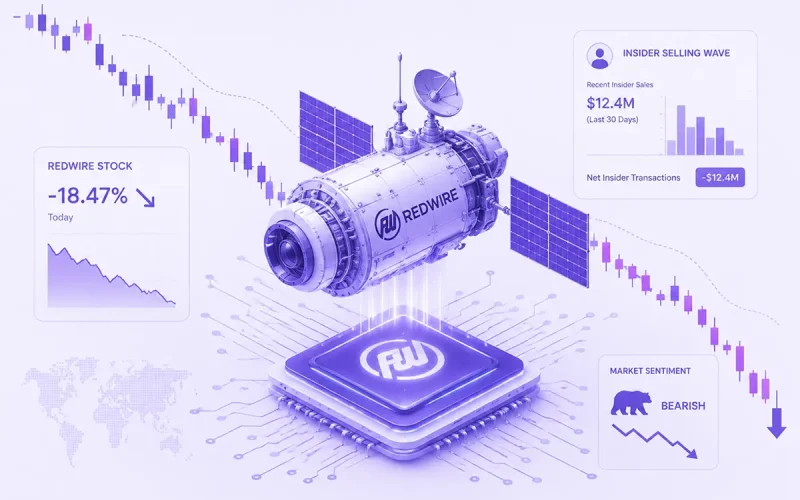
Following many substantial share sales by a major holder, Redwire Corporation had a steep fall, bringing insider selling stocks back into the spotlight. As investors responded to the abrupt rise in supply, the stock gapped down and kept declining.
According to recent disclosures, AE Red Holdings sold millions of shares in a number of transactions in April, which caused a significant backlash. Although insider selling isn’t necessarily negative, short-term traders were concerned by the size and timing of these trades.
So, let’s learn more about why traders are concentrating on the following!
What Caused Redwire’s Stock Drop?
Following a string of insider transactions that drastically lowered ownership holdings, Redwire shares plummeted. Traders following Insipix online stock trading activity quickly noticed how repeated large-scale selling accelerated bearish sentiment and increased volatility.
Strong market involvement throughout the selloff was substantiated by a high trading volume of more than 12 million shares. This kind of pricing difference frequently indicates abrupt changes in attitude brought on by fresh information.
The main facts underlying the insider selling activities are as follows:
- In one transaction, more than 2 million shares were traded for about $10.77.
- Extra sales of 1.76 million and 977,000 shares during the course of two days
- Over $50 million in total transaction values over several filings
- Each transaction saw a reduction in ownership interests of between 4% and more than 7%.
Because of the ongoing supply overhang caused by these frequent sales, it was challenging for the stock to stabilise in the near future. Consecutive insider sales are usually seen by traders as a stronger signal than individual transactions.
It should be noted that several insider sales within a brief time frame frequently have greater weight than a single transaction.
Comprehending Insider Selling in a Market Setting
Depending on the situation, the timing, and the company’s fundamentals, insider stock sales might send conflicting signals. Executives may sell for liquidity or diversification purposes, thus not all insider transactions portend bad things.
But given Redwire’s recent financial results, the extent of its insider engagement is noteworthy. Concerns were heightened when the corporation revealed negative margins and failed earnings targets.
Traders interpret insider selling signals as follows:
- Reduced confidence may be indicated by large and consistent sales.
- When fundamentals are weak, sales can intensify pessimism.
- Volatility is increased when insider activity and high volume are coupled.
- An insider’s purpose is frequently less important than market perception.
Insider selling was associated with increased volatility and speculative trade flows in Redwire’s situation. This combination can accelerate price movements in both directions.
Analyst Outlook and Fundamental Risks
Analyst sentiment on Redwire is still largely optimistic despite the current selloff. The stock has an average price target of about $13.89 and a consensus rating of moderate buy. As a result, short-term price movement and longer-term expectations are contrasted. When analyst outlooks and technical indications diverge, traders frequently encounter difficulties.
Redwire’s primary fundamental measurements are broken down as follows:
| Metric | Value | Signal Type | Interpretation | Trader Focus | Risk Level |
| Share Price Range | ~$10–$11 | Volatile | Recent sharp decline | Stabilization levels | High |
| Market Capitalization | ~$2.06 Billion | Small Cap | Higher risk profile | Liquidity trends | High |
| EPS | Negative | Weak | Missed expectations | Earnings recovery | High |
| Net Margin | -67.55% | Negative | Profitability concerns | Cost management | High |
| Return On Equity | -13.04% | Negative | Inefficient capital use | Improvement signals | Medium |
| Analyst Target Price | $13.89 | Bullish Bias | Upside potential | Re-rating catalysts | Medium |
The company’s financial picture is still a concern, despite some assistance from analyst upgrades and improving backlog patterns. Traders need to strike a balance between risk awareness and optimism.
Advice: It’s important to assess conflicting signals between market behaviour and fundamentals carefully.
How Insider-Driven Moves Are Handled by Traders
Traders frequently use a combination of technical and behavioural analysis when handling insider selling stocks. Similar pressure patterns can also be observed in sectors affected by transportation stocks supply chain disruptions, where sentiment shifts rapidly after negative operational developments.
While longer-term viewpoints take into account whether fundamentals support recovery, short-term methods frequently concentrate on volatility. This two-pronged strategy is particularly crucial in developing industries.
Traders can examine insider-driven moves in the following useful ways:
- Monitor surges in volume to verify market involvement
- Keep an eye out for patterns of continuation or reversal in price gaps.
- Insider activity and company fundamentals should be compared.
- Keep an eye out for new catalysts or analyst adjustments.
By using these actions, traders can respect market signals and refrain from impulsively responding to headlines. When assessing insider activity, discipline is crucial. Be aware that prolonged periods of volatility may result from high-volume insider selling occurrences.
Volatility in the Space Sector and General Trends
Redwire works in the space infrastructure industry, which has a significant potential for growth but also a high level of risk. Many traders reviewing the broader situation through risk management for traders frameworks are paying closer attention to position sizing and exposure control during speculative sector swings.
Investor interest has increased due to recent developments, such as possible IPO activity in the space industry. But this also makes you more vulnerable to harmful catalysts like insider sales.
A difficult environment is created for traders by the mix of economic expectations and financial instability. Comprehending sector dynamics can offer significant context for the movements of individual stocks.
Note: Both positive and negative market reactions are often amplified in emerging sectors.
Conclusion
Redwire’s recent collapse shows how large-scale share sales can affect sentiment and price action, and insider selling stocks continues to be a crucial indication for traders. There was significant downward pressure due to insider activity, poor fundamentals, and extreme volatility.
Even while analyst projections point to possible gains, sentiment and trading activity will probably continue to have an impact on short-term developments. Traders are better able to handle these circumstances when they are aware of the subtleties of insider behaviour.